|
View in browser |
 |
|
|
|
|
Dear friends of the Dais,
As the school year draws to a close, a powerful wave is building across the country as more Canadians demand action to rein in the role of tech in young people’s lives and schools.
In Ottawa, overwhelming public opinion and advocacy from parents, pediatricians, mental health experts and premiers have spurred the federal government to reintroduce online safety legislation for social media platforms. The bill is expected within weeks. After years of work on this file, the Dais’ call to parliamentarians is simple: get on with it.
Meanwhile, in provinces Canada-wide, calls are mounting for strengthened efforts to govern technology use in schools. By 2024, all provinces had introduced restrictions on the personal use of phones in classrooms. This was a good start, but our work has found that implementation has been patchy across the country.
Our Heads Up campaign presses provinces to up their game. Based on evidence and public opinion, coast-to-coast perspectives, and international examples, our core recommendations are:
- Extend phone policies to “bell-to-bell” full day for all grades
- Increase on-the-ground implementation support for students, educators and schools
- Better track and evaluate progress.
At the same time, a new challenge has emerged: artificial intelligence (AI). In a new op-ed article, former Ontario Deputy Minister of Education, Nancy Naylor, and I highlight both the urgency and complexity of preparing for AI in education.
Plus, in this newsletter:
- Meet: our 2026 Youth Champions who are leading the charge to go phone free at school in communities across Canada
- Read: a new Teaching Guide for K-12 educators, which provides information and activities to support reflections on phone use and building healthier digital habits
- Reflect: read our recap of Canada's first screenings of Your Attention Please, a powerful documentary that examines the impact of social media on teen mental health.
Finally, for education ministers across Canada, here's your summer homework: move quickly to strengthen provincial phone policies and supports, and preparations for AI in classrooms, before the new school year starts in September. We’re here to help.
André Côté
Executive Director
The Dais at Toronto Metropolitan University
|
|
|
|
|
|
|
Youth Champions: Meet the 2026 Cohort |
 |
|
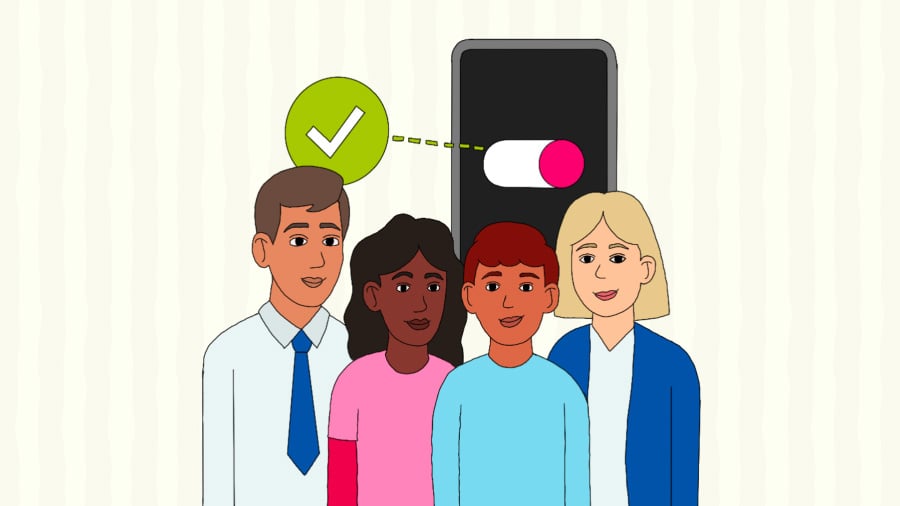
We are proud to introduce the second cohort of Heads Up Youth Champions — 10 remarkable high school students from across Canada who will spend the coming months leading conversations about phone-free schools, digital wellness, and healthy tech habits in their communities.
From Grades 9 to 11, each Youth Champion brings a unique voice, lived experience, and a bold vision for change. They are student council leaders, athletes, activists, theatre performers, and community volunteers.
|
|
|
 |
|
Suki
Ontario |
|
|
|
|
|
 |
|
Kailee
Northwest Territories |
|
|
|
|
|
 |
|
Ruona
Alberta
|
|
|
|
|
|
 |
|
Holly
Newfoundland & Labrador
|
|
|
|
|
|
 |
|
Princess
Manitoba |
|
|
|
|
|
|
|
Phone free, from bell-to-bell |
 |
|
Since 2024, the Dais has been mobilizing to reclaim focus, learning, and connection at schools by going phone-free through our Heads Up program.
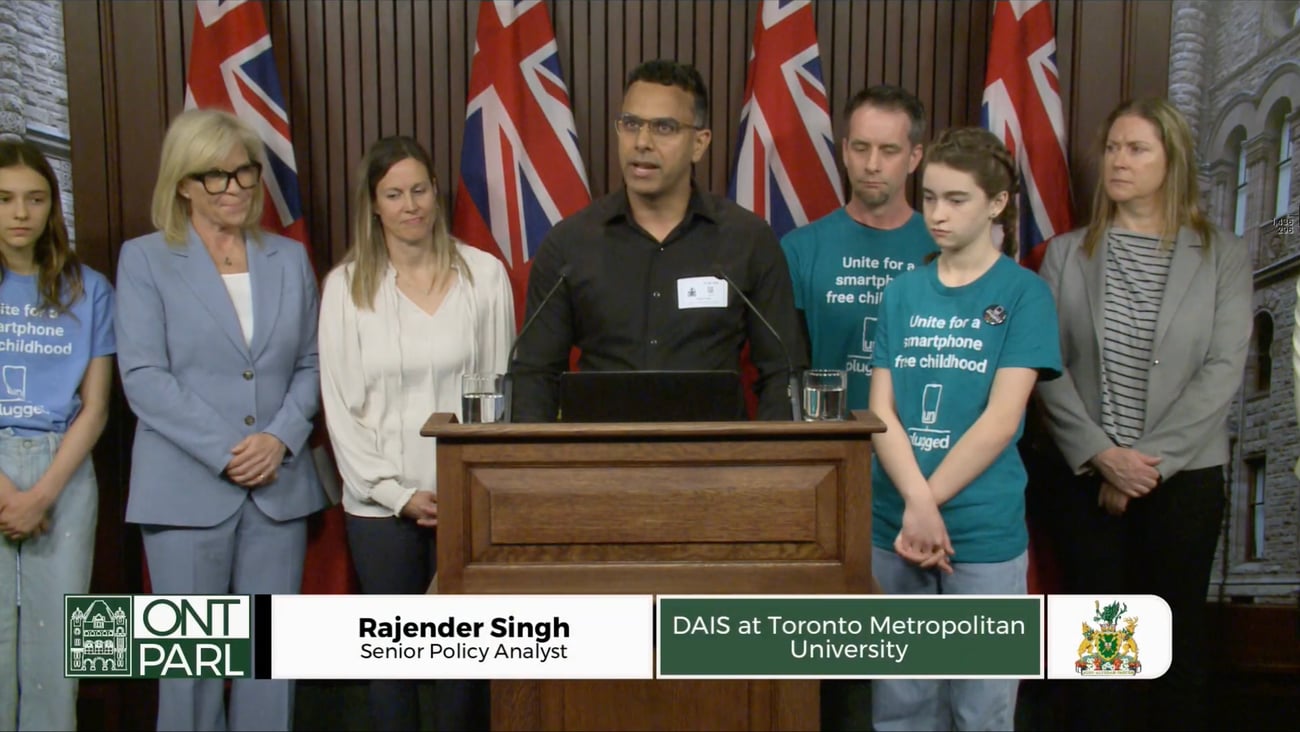
This week, our program lead, Rajender Singh, joined leaders from the Phone-Free Schools Movement, Unplugged Canada, and RAADD at Queen’s Park in Toronto to call on the province to support putting phones away, all day, in school.
He shared the findings of our 2025 survey which found that, while Canadians overwhelmingly support phone restrictions in schools, they’re split about how effective they think these policies are in practice.
His advice?
“Schools need support to make phone restrictions actually work, with clear guidance on storage and enforcement, and resources for teachers. No single intervention is going to solve the problem.”
Since 2024, the Dais has been mobilizing to reclaim focus, learning, and connection at schools by going phone-free through our Heads Up program.
Explore our free toolkits and resources for students, educators, and policymakers at dais.ca/HeadsUp.
|
| READ MORE |
|
|
|
|
Recap: Your Attention Please Film Screenings |
|
|
|
|
|
|
|
The Dais hosted the first Canadian screenings of the acclaimed documentary, Your Attention Please, in partnership with Sick Kids Child Health Accelerator.
In Toronto and Ottawa, we joined members of the documentary team, Sara Robin, Kristin Bride, Joni Siani, and Alysse Houliston, to share this film with a growing community of Canadians passionate about protecting children and teens from online harms. In each city, young leaders, parents, and educators participated in a live audience Q&A, diving deeper into the themes of the film: online bullying, the addictive nature of social media apps, and community organizing to mobilize change.
Dr. Alene Toulany, incoming Head of Adolescent Medicine at SickKids, emphasized the need for youth voices to be heard in conversations about designing solutions for safer online environments.
One of our 2026 Heads Up Youth Champions, Suki Huang, spoke to her experience navigating social media as a current high school student. In Ottawa, Sasha Banks, a high school student and Vote16 Canada advocate, highlighted the need to support youth in building healthy relationships with technology.
Sara Robin, the Director and Co-Producer of Your Attention Please, spoke to the importance of shifting our perspectives to realize the benefits and joys that can come from going offline.
A special thanks to the Your Attention Please team for collaborating with us as we work to inspire schools across Canada to go phone-free.
|
| CHECK OUT THE FILM |
|
|
|
|
Op-ed
Canada’s AI Strategy Must Address the Technology’s Use in K-12 Education |
 |
|
(Spencer Colby/The Canadian Press via AP)
Canada is releasing a new national AI strategy today. All signs point to economy-wide adoption as the priority, but the front lines of AI adoption are already here: the K–12 classroom.
In a new piece for Tech Policy Press, André Côté, the Dais' Executive Director, and former Ontario Deputy Minister of Education Nancy Naylor argue that school systems are not ready for the AI wave, and that the national strategy is needed.
They lay out four areas requiring coordinated action: AI literacy and skills; reinforcing students' AI-resilient human capacities like communication and critical thinking; thoughtful use of AI in teaching and school administration; and governance frameworks for youth safety, privacy, and cybersecurity.
|
| READ THE OP-ED |
|
|
|
|
Teaching Guide on Phone Restrictions and Digital Wellness |
 |
|
We've launched a new Teaching Guide to support K–12 educators across Canada with classroom activities and lesson plans designed to engage students on technology use and digital wellness at school.
The guide contains two parts:
-
Part 1: Essential context for teachers about the “Heads Up” initiative (going phone free) and the evidence behind phone restrictions.
-
Part 2: A menu of adaptable instructional activities categorized by relevant grade bands.
The guide is designed to align with provincial curriculum expectations across provinces,
including Literacy/English/French, Digital Literacy, and Health.
It is a companion tool to our existing catalogue of resources for educators and school leaders: a practical phone policy Implementation Guide , shareable Infographics, and Lunchroom webinar series. |
| VIEW TEACHING GUIDE |
|
|
|
|
ICYMI: Education Minister Paul Calandra |
 |
|
The 48th TMU Democracy Forum featured a timely conversation with Ontario Education Minister Paul Calandra, interviewed by Toronto Star columnist and Dais Senior Fellow Martin Regg Cohn and journalist Kris Rushowy.
Ashna Ali, Lead of our Heads Up Youth Champions, pressed the Minister on the path forward for phone-free schools in Ontario. His response was candid: device use worries him, teachers need backing to enforce existing rules, and he is actively reviewing other approaches, including Quebec, Australia, and several European jurisdictions.
Watch the full recording, and stay tuned for future Democracy Forums!
|
| WATCH FULL RECORDING |
|
|
|
|
In the News |
|
|
|
“You Can’t Recycle Your Way Out of a Wildfire:” Notes from DemocracyXChange 2026 (The Starfish)
The Starfish's coverage of DemocracyXChange 2026, featuring Ashna Ali, Leadership Development Facilitator, on youth leadership and civic engagement in the face of climate and policy challenges.
Canadians worried about online misinformation, as it becomes increasingly harder to spot: report (CTV News)
Angus Lockhart, Senior Policy Analyst, speaks to CTV News on a new Statistics Canada survey finding that nearly half of Canadians are finding it harder to distinguish fact from fiction online.
Sam Altman testifies in Musk lawsuit, calls himself ‘honest’ (Global News)
Jake Hirsch-Allen, Director of Partnerships, speaks to Global News on Sam Altman's testimony in Elon Musk's civil lawsuit seeking his removal from OpenAI leadership.
Concerns raised over growing number of data centres in the GTA (CityNews)
Viet Vu, Manager of Economic Research, discusses the rapid growth of AI data centres across the GTA and the community concerns they are raising around energy use and neighbourhood impact.
Charity leaves online safety coalition before announcing Google dea (Investigative Journalism Foundation)
André Côté, Executive Director, speaks to the Investigative Journalism Foundation on how tech companies use funding partnerships with civil society organizations as a tactic to avoid government regulation and the real stakes for charities dependent on that funding.
|
|
|
|
|
|
|
AI Action Summit: Turn AI Into ROI |
 |
|
JOIN US on June 10 at TMU's AI in Action Summit, and find out how!
As AI rapidly reshapes institutions, economies, and civic life, Canadian policymakers, educators, and public sector leaders are being called to respond with clarity and strategy.
Hosted by The G. Raymond Chang School of Continuing Education, the AI in Action Summit: Experimentation to ROI will bring together leaders exploring the intersection of technology, governance, innovation, and public trust.
This immersive, hands-on summit moves beyond theory to examine how AI can drive measurable impact while addressing critical societal questions.
Featured sessions include:
Where Am I With AI? Kick off the summit with Jake Hirsch-Allen, Director of Partnerships and Advocacy at The Dais at Toronto Metropolitan University, as he guides participants through an engaging self-assessment designed to uncover their current AI confidence, skills, and concerns.
Privacy in the Age of AI: Join renowned privacy expert Ann Cavoukian for a thought-provoking discussion about how she uses the Privacy by Design framework (an ISO standard) to help business leaders understand how responsible AI use is not only compatible with privacy, but essential for operational efficiency and organizational success.
From Experimentation to ROI: André Côté, Executive Director of The Dais, moderates a panel featuring leaders from strategy, operations, and governance discussing how organizations move beyond experimentation to sustained AI value.
Location: Peter Bronfman Learning Centre, Heaslip House, 297 Victoria Street, Toronto | 7th Floor |
| REGISTER NOW |
|
|
|
Promise in Practice Award Nominee |
 |
|
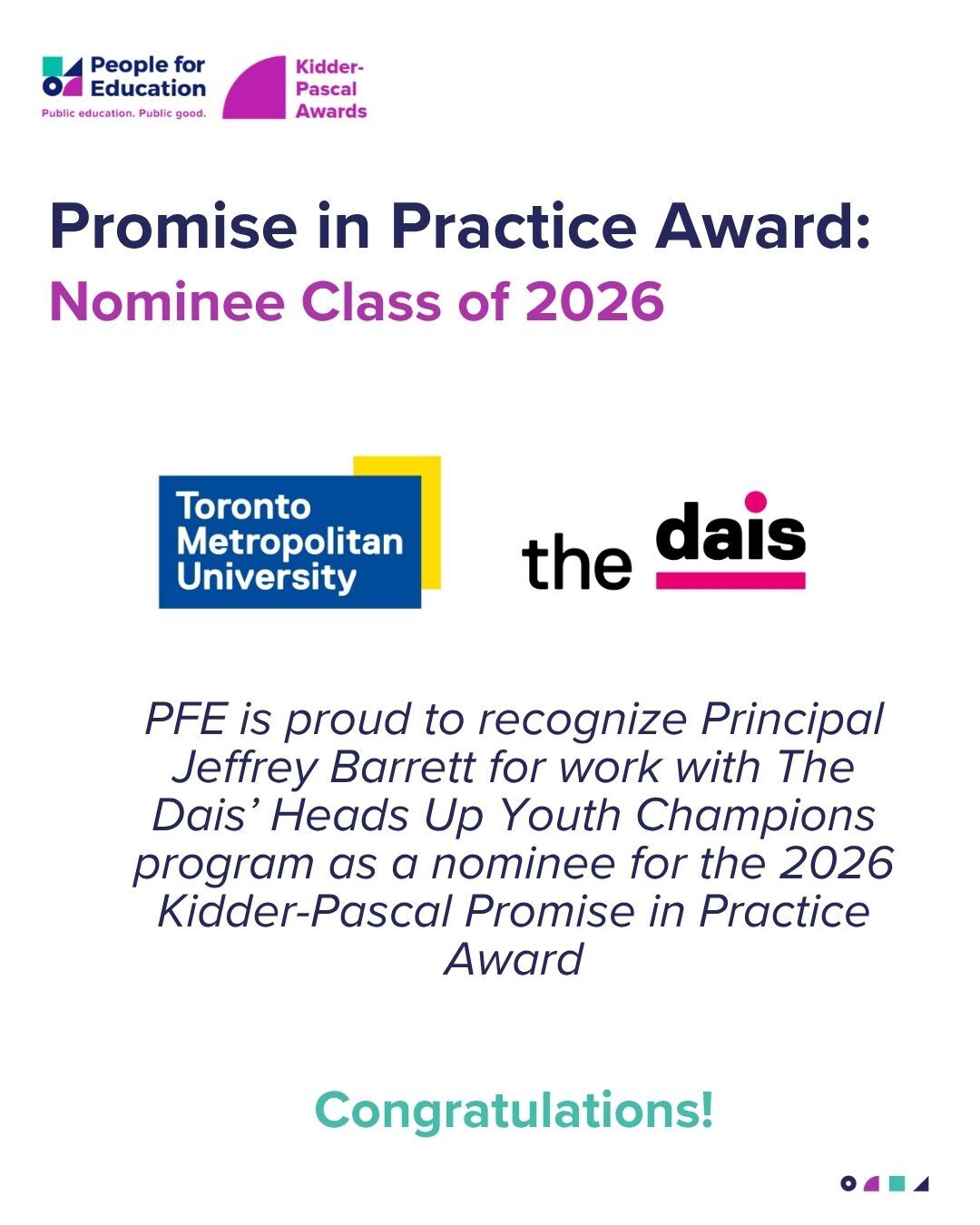
People for Education is proud to recognize Principal Jeffrey Barrett for work with the Dais’ Heads Up Youth Champions program as a nominee for the 2026 Kidder-Pascal Promise in Practice Award. |
| KIDDER-PASCAL AWARD |
|
|
|
|
|
|
|
|