|
View in browser |
 |
|
|
|
|
Dear friends,
Last week’s National Day of Unplugging offered a simple, but powerful reminder: attention is the currency of learning. Yet, as our commentary article below highlights, school systems across Canada are struggling to refocus it on what’s most important for students. Learning. Thinking. Actively participating. Working together.
Over the past couple of years, all 10 provinces have introduced or updated restrictions on students’ use of personal phones and digital devices at school. This is an important first step. It's overwhelmingly supported by Canadians. But our work - engaging students, educators and parents, conducting surveys and research, looking at international examples - reveals that much more needs to be done to see real impact on the ground, in classrooms across the country.
That’s why we’re launching the next phase of our Canada-wide Heads Up campaign for phone-free schools. Our core message, based on early lessons about what works: we need a shift towards “bell-to-bell” policies across the school day, clearly communicated and consistently enforced by school leaders and educators, policymakers and parents. This must be coupled with a focus on putting students at the centre of the conversation and empowering them to lead change.
To support these efforts, we’re introducing:
-
For policymakers: a playbook and updated resources to improve phone policies and their impact.
-
For educators: a practical school implementation guide and a monthly Lunchroom webinar series to share lessons and best practices from across the country.
-
For students: an expanded Youth Champions Program, which equips student leaders to engage their peers on phone policies and digital wellness in schools.
Today, we're also excited to launch an online engagement to hear from K-12 communities across Canada about their experiences with school phone restrictions, and to gather ideas about how to ensure they are successful.
There will be more over the coming months. You can expect new learning opportunities and lesson plans to support teachers, news about our next cohort of Youth Champions, and special events and opportunities that inspire healthier digital habits, like the January Screen Break launch event on campus with Rogers and Toronto Blue Jays pitcher Trey Yesavage.
Technology presents both immense opportunities and complex challenges in our schools and our lives. We must seize the agency to shape our future, and ensure those closest to classrooms have the tools, information, and space they need to lead the way.
André Côté
Executive Director
The Dais at Toronto Metropolitan University
|
|
|
|
|
|
|
|
Have Your Say on School Phone Policies! |
 |
|
Calling all students and educators!
If you're a high school student or teacher, principal, school or board administrator, we want to hear about experiences with school phone policies, and get your input and ideas about how to ensure phone rules are fair, practical and effective. Your views are critical to our Heads Up project.
Using the Canadian-made Ethelo platform, the engagement is easy to complete and will only take 5 to 10 minutes.
Want to win a $20 Tim Hortons gift card? Leave your email at the end to be entered into the draw.
Join the conversation:
For High School Students Engagement
For Educators Engagement (for teachers, principals, school and board administrators)
|
|
|
|
|
Heads Up Toolkits & Resources |
 |
|
We’ve created a set of practical resources to support phone-free schools, whether you’re advocating as a student, educator, or policymaker.
For Students
Bring the phone-free campaign to your school
We’re still looking for Youth Champions in PEI, Quebec, Yukon, and Nunavut! Lead change in your school, shape phone-free policies, and earn a $1,000 honorarium while building leadership skills.
For Educators
Resources for effective phone rules in schools
School Implementation Guide
Webinar Series
Heads Up Infographics
For Policymakers
Insights to help design effective provincial and school board policies
Interactive Phone Policy Map
Provincial Roundtable Reflections
National Survey Brief
For Everyone
Key facts, arguments and guidance for advancing phone free school policies
Advocacy Brief
|
| EXPLORE OUR TOOLS |
|
|
|
|
|
|
Webinar Series
The Lunchroom: Making Phone-Free Schools Work |
 |
|
Phone-free school policies have been announced in every province for nearly 18 months. With differences between and within provinces, many school communities are asking the same question: what does “phone-free” actually look like on a random Tuesday at lunch, in the hallway, or in a classroom?
The Lunchroom: Making Phone-Free Schools Work is a webinar series featuring education leaders who are bringing phone-free policies to life in schools every day. Each session brings together voices from the field to share candid, on-the-ground lessons on what’s working, what’s not, and the lessons they’ve learned along the way.
These sessions are for anyone who cares about making phone-free policies work in schools, including:
-
School board leaders
-
School Administrators
-
Educators
-
Parents
-
Civil society partners
Join us for all sessions—or drop into the ones you can. Bring your lunch and your questions, and leave with practical ideas you can apply in your school.
|
| REGISTER |
|
|
|
|
Let Students Lead Canada’s Phone-Free Revolution — With Rules That Actually Hold |
 |
|
NEW COMMENTARY ARTICLE
Students across Canada are navigating a constant battle for their attention, and many schools are responding with phone restrictions. But rules alone aren’t enough.
In this new piece for the National Day of Unplugging, the Dais Leadership Development Facilitator, Ashna Ali, explains why students should be at the centre of shaping phone-free policies, turning restrictions into shared commitments that actually work.
|
| READ THE ARTICLE |
|
|
|
|
Meet the New Heads Up Fellows |
|
Our Heads Up Fellows bring diverse perspectives from education, technology, community, and youth engagement to help guide the Heads Up activities and outreach across the country.
|
|
|
Chris Hicks
Chris has served as a school administrator since 2000, leading schools across all grade levels, most recently a rural K–12 French Immersion school in Manitoba. His leadership portfolios have included student services and inclusion, French Immersion, and vocational and career technology.
He holds a Master’s degree in Educational Administration and Psychology from the University of Manitoba, where his thesis explored values and ethics in principals’ decision-making.
An active member of the Manitoba Teachers’ Society and the Council of School Leaders, Chris’s research focuses on school leadership and, since 2017, the impact of smartphone use on adolescents.
He lives in rural Manitoba with his wife and two sons.
|
|
|
Melody Yun Ya Ma 馬勻雅
Melody Yun Ya Ma 馬勻雅 (she/her) is a Hakka 客家 Toisan 台山 Chinese second-generation settler living on the unceded territories of the Musqueam, Squamish, and Tsleil-Waututh Nations (Vancouver, Canada). She is a multidisciplinary entrepreneur working at the intersection of technology, culture, and social change.
She is the Founder of FormPay, an e-commerce platform for micro-merchants, and Ecosystem and Strategic Engagement Lead at DemocracyXChange. She previously co-founded Podyssey Podcasts (1.5M annual users) and has led product, civic tech, and coding education initiatives across Canada.
A Fellow of the United Nations Alliance of Civilizations and the EU Global Cultural Relations Platform, her writing has appeared in The Economist, CBC, Maclean’s, Globe and Mail, Toronto Star, Vancouver Sun, and South China Morning Post.
|
|
|
Travis Saunders
Travis Saunders is a Professor in the Department of Applied Human Sciences at the University of Prince Edward Island, and a co-founder of the Sedentary Behaviour Research Network.
His work studies the health impacts of sedentary behaviour across the lifespan. He co-authored Canada’s 24-Hour Movement Guidelines for children and adults, and led the development of International School-Related Sedentary Behaviour Recommendations for the Sedentary Behaviour Research Network.
He is also a passionate advocate for reduced use of all screens in classroom settings.
|
|
|
|
|
|
|
|
|
Blue Jays' Trey Yesavage kicks off
Rogers Screen Break |
 |
|
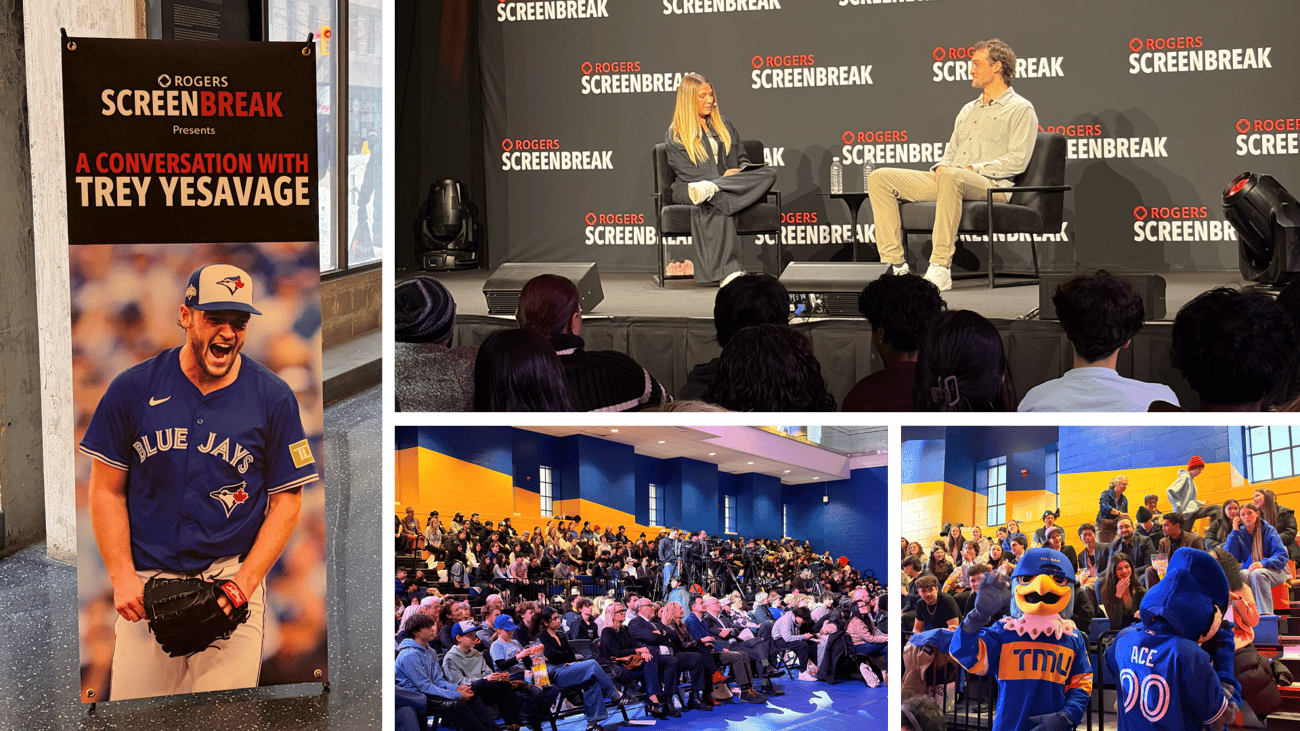
The Mattamy Athletic Centre was packed as students, educators, and families gathered for the launch of Rogers Screen Break at TMU.
Hosted by the Dais, the event blended sports, storytelling, and youth leadership — featuring Toronto Blue Jays pitcher Trey Yesavage, Sportsnet host Danielle Michaud, and Heads Up Youth Champion Aysha Lafir.
Through live Q&A, student stories, and a crowd pledge to “Look Up. Show Up. Focus is Power,” the event kicked off a national effort to help young people reclaim focus and build healthier relationships with technology.
|
| LEARN ABOUT ROGERS SCREEN BREAK |
|
|
|
|
|
|
|
|
|
|